
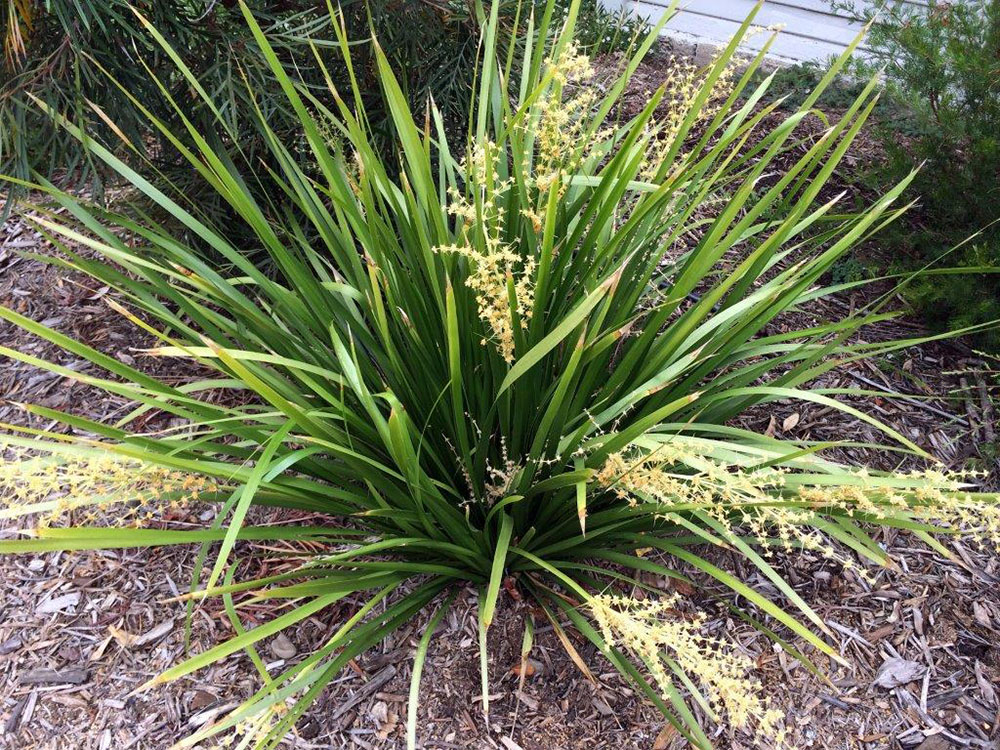
Lomandra ‘Tropic Belle’
The grass-like Lomandras are fairly new in California but they are becoming increasingly popular. Many varieties are new cultivars introduced for their hardiness, growth habits and tolerance for a spectrum of climates and garden conditions.
These relatives of lilies and grass trees (Xanthorrhoea) are extremely useful Australian plants. Landscapers use them in mass plantings under established trees or in informal drifts across a garden, but they work well as single accent plants too.
Lomandras do well in a wide range of conditions: from full sun to deep shade, in sandy soils to heavy clays. They will survive temporary wet conditions, in fact they can sit in water for several days. So, for example, Lomandra ‘Tropic Belle’ is often planted along a dry waterbed and Lomandra ‘Breeze’ is often used to soften a creek or water course in the landscape. Of course this tolerance of excessive water will be handy if we experience El Niño conditions as expected this winter.
Lomandras are excellent at taking up phosphorus in soils. The soils in Australia are low in nutrients, particularly phosphorus, so if phosphorus is abundant in local soil it can be detrimental to most Australian plants. For this reason Lomandras make great companion plants for other Australian trees and shrubs.
The foliage is often darker if grown in deep shade. Some varieties, for example Lomandra ‘Katie Belles’ have sweetly scented white flowers; in spring the perfume of Lomandra ‘Tropic Belle’ is especially strong in the early mornings and evenings.
The flowers and the mustard yellow seed pods are often used for indoor decorations and as cut flowers. The leaves are tough and used to weave baskets and bags. The seeds and base of the leaves are also eaten by the aboriginals like a celery.
Lomandras are so tough and tolerant they can be grown in coastal situations, in the heated inland valleys, at higher elevations where there is frost and snow and at the base of slopes where there is often wet fog and cold. As great indicator plants they will let you know if your garden is too dry because they can withstand excessive dry as well as wet. They also tolerate smog!
These plants sometimes need to be cut back to tidy up older leaves. If reduced to a tight mound around 6″ tall, within 3 weeks they will regenerate into a lovely form.
If the above isn’t enough to make you fall in love with Lomandras, they attract birds, bees and butterflies! Some selected cultivars are: Lomandra ‘Breeze’; Lomandra ‘Shara’; Lomandra ‘Katie Belles’; Lomandra ‘Tropic Belle’; Lomandra ‘Katrinus’.
RECOMMENDED PRODUCTS
[content_block id=6548]
[content_block id=7365]
[content_block id=7381]
[content_block id=6566]


